AzzyAir
Empowering users to make informed decisions about air quality by providing real-time data, personalised alerts, and safe route planning, ensuring a healthier and more sustainable lifestyle.
Empowering users to make informed decisions about air quality by providing real-time data, personalised alerts, and safe route planning, ensuring a healthier and more sustainable lifestyle.
Overview
For the Prodigi Product Innovation Program, our team of four UX/UI designers worked under a product manager to design a digital healthcare solution. I contributed to research, user testing, mockups, and prototyping, focusing on self-care support and healthcare transparency.
Role
UX/UI Designer, User Researcher
Team members
Kim Ngoc (Mari) + 4 members
Duration
Sep-Nov 2024, 9 weeks
Tools

Solution 💡
Solution 💡
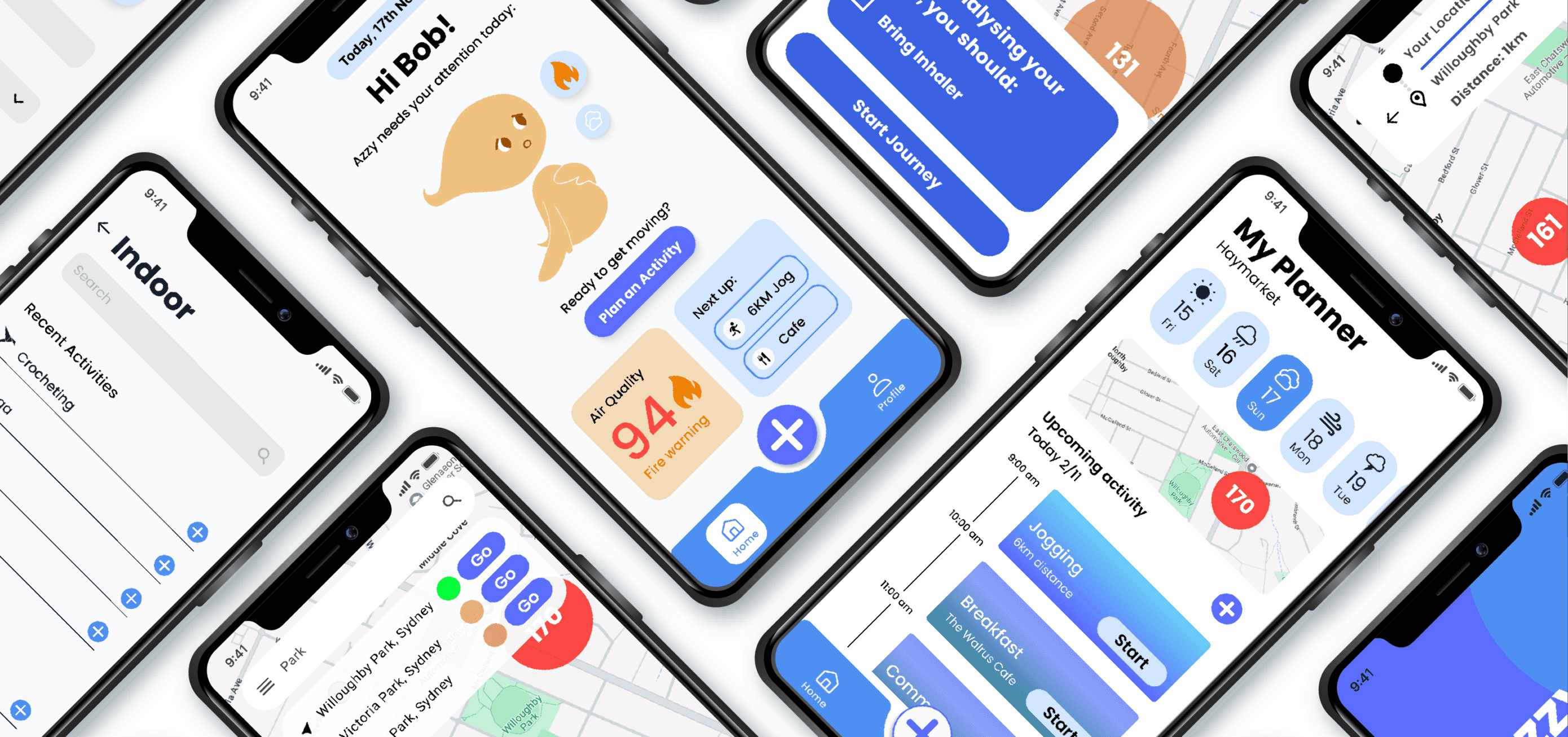
AzzyAir is a smart air quality monitoring app with real-time alerts and personalised recommendations, helping users make informed decisions about outdoor activities. With dynamic colour-coded indicators and a clean-zone route planner, AzzyAir ensures safer travel and promotes healthier lifestyle choices in varying air conditions.
AzzyAir is a smart air quality monitoring app with real-time alerts and personalised recommendations, helping users make informed decisions about outdoor activities. With dynamic colour-coded indicators and a clean-zone route planner, AzzyAir ensures safer travel and promotes healthier lifestyle choices in varying air conditions.
The problem 📌
The problem 📌
Despite advancements in Australia’s healthcare, outdoor commuters with asthma struggle with unpredictable symptoms during activity. Existing systems lack effective patient-provider engagement for better management.
Despite advancements in Australia’s healthcare, outdoor commuters with asthma struggle with unpredictable symptoms during activity. Existing systems lack effective patient-provider engagement for better management.
Discover 🔭
Discover 🔭
Secondary research
2.8
Million
2.8
Million
people in Australia live with asthma (2023)
97%
97%
believes their asthma limits their daily tasks
2 in 3
2 in 3
people with asthma are affected by poor air quality
Opportunity 🔑
Opportunity 🔑
The health-tech market in Australia is on a rapid growth trajectory, with the Digital Health sector expected to expand by more than 8% to 2029, reaching a market value of $62 million. As chronic conditions like asthma become more prevalent, there is increasing demand for innovative solutions. Currently, there are over 1,500 apps targeting asthma patients, but the adoption rate among this group is shockingly low, under 1%. There are two main challenges:
The health-tech market in Australia is on a rapid growth trajectory, with the Digital Health sector expected to expand by more than 8% to 2029, reaching a market value of $62 million. As chronic conditions like asthma become more prevalent, there is increasing demand for innovative solutions. Currently, there are over 1,500 apps targeting asthma patients, but the adoption rate among this group is shockingly low, under 1%. There are two main challenges:
Limited value
Most asthma-focused apps are simply tracking tools, offering little beyond basic symptom logging, and failing to integrate key features like environmental sensing or air quality forecasting.
Lack of behavioural support
Apps that help users make lasting behavioural changes, such as offering tailored exercise advice or tracking physical activity across platforms are notably absent, despite their proven effectiveness for other chronic illnesses.
A personal planner that allows users to schedule activities like jogging while considering their asthma condition.
A map feature similar to Google Maps, but enhanced to show areas with poor air quality, helping asthma users make safer, more informed decisions about where and when to be active.
How might we💭
How might we offer personalised digital support systems and improve information transparency to help asthma patients effectively manage their symptoms, thus integrating health management into their lifestyle to improve quality of life?
Defining the MVP🥇
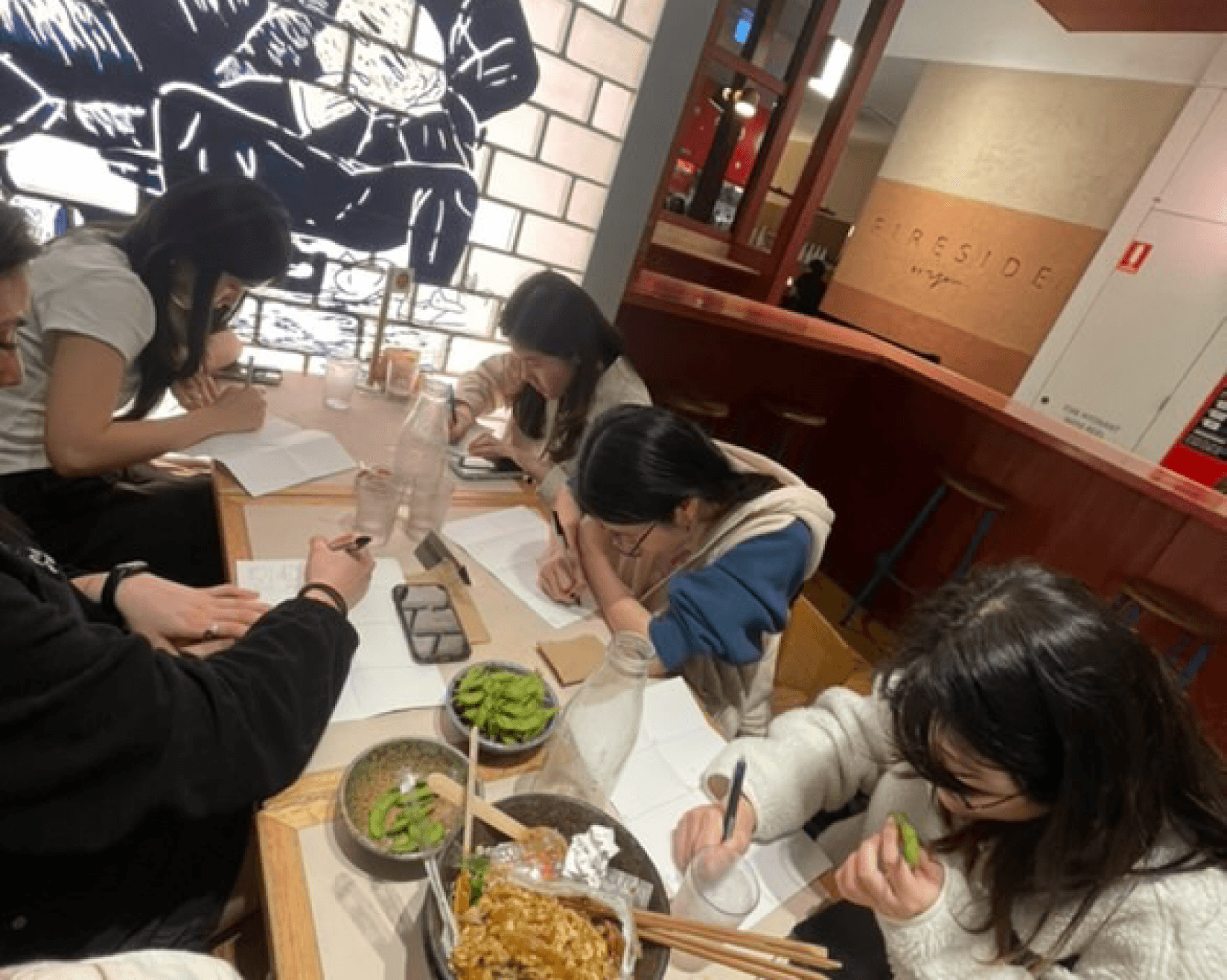
As a group, we use the Crazy 8s technique to quickly generate a wide range of ideas, sketching out anything we thought could be useful for the app. Some of us came up with similar concepts, while others explored different directions. After discussing and evaluating the ideas, we initially narrowed our focus down to three MVP features: an activity tracker , a pill and inhaler tracker , and a healthcare provider connection tool .
However, after further iterations and feedback, we refined our MVP to focus on two core features:
User Persona👨💼
User Persona👨💼
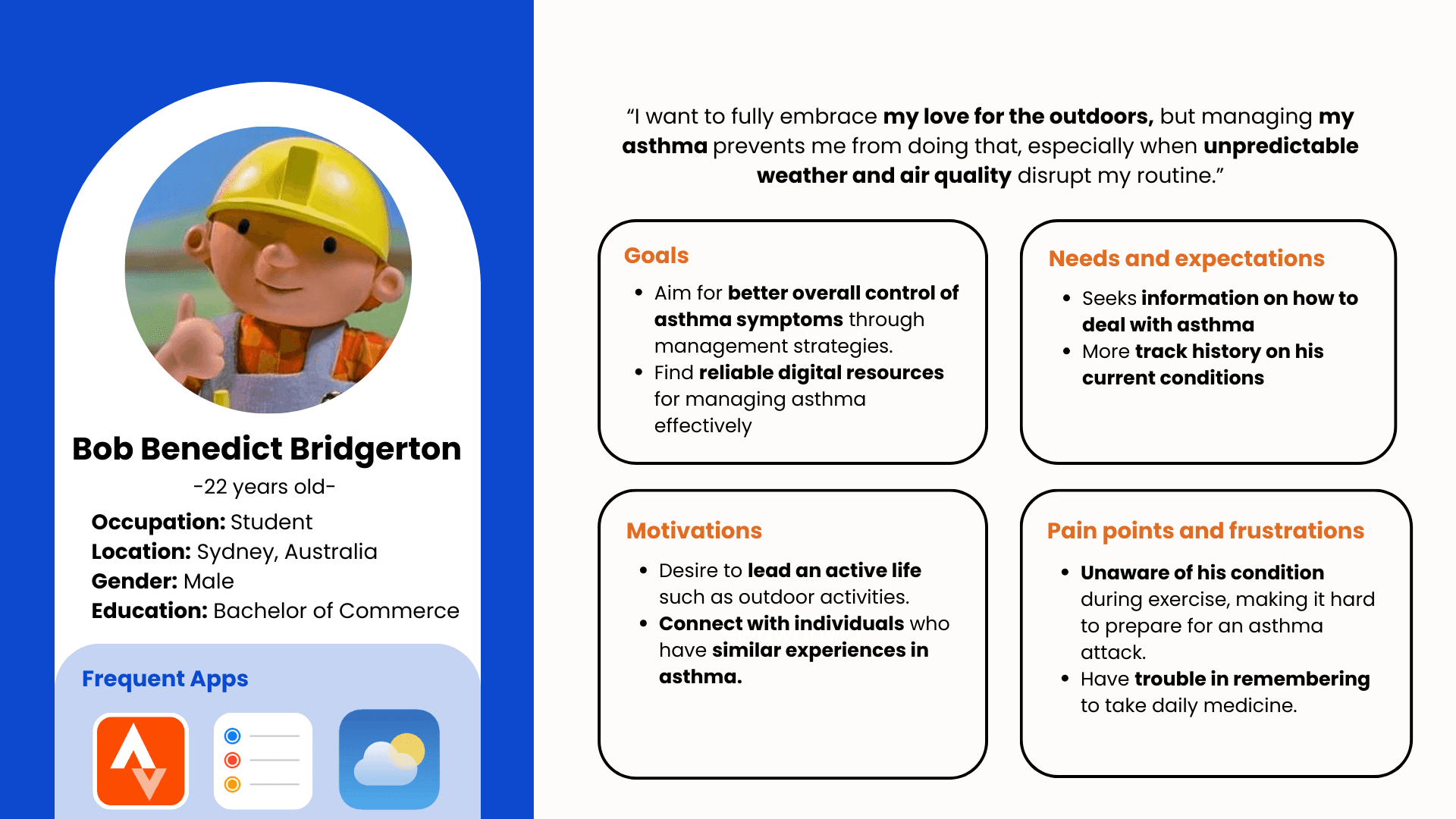
After diving deep into our research, we created a user persona that brings the story of asthma management to life. This persona highlights the real challenges and needs of individuals like Bob, who struggle to balance their health with an active lifestyle. It shows their desire for simple and effective tools that not only help manage their condition but also allow them to stay active and engaged in the activities they love.
After diving deep into our research, we created a user persona that brings the story of asthma management to life. This persona highlights the real challenges and needs of individuals like Bob, who struggle to balance their health with an active lifestyle. It shows their desire for simple and effective tools that not only help manage their condition but also allow them to stay active and engaged in the activities they love.
Usability testing📊
To evaluate the mid-fidelity prototype, we conducted think-aloud sessions, post-experience interviews, and a SUS (System Usability Scale) survey. As users navigated the app, they shared their thoughts in real time, revealing moments of confusion and suggesting improvements. While the SUS results indicated that the system was not overly complex to use, some users pointed out inconsistencies in elements such as font sizes, spacing and layout. These findings helped us make design improvements to make the app easier to use and understand.
Through this process, we identified three key usability issues:
Clearer feature relevance
“I think having one location as a title can be confusing as I felt that this represents more like a weather application. I think the title could be changed to something else more related to the plan.”
Streamline scheduling
“For the schedule page I would want to see my schedule as a whole, like not looking at the weather like it's the first thing you see but I want to check my schedule.”
Smarter activity planning
“I think it is better to give the user a better route because from what i'm seeing in the air quality page with the route it shows red which means it is dangerous right? like we don’t want to harm the user so is better to suggest them a better route”
Final design🎉
Final design🎉
UI Design Style Guide👨🎨
UI Design Style Guide👨🎨
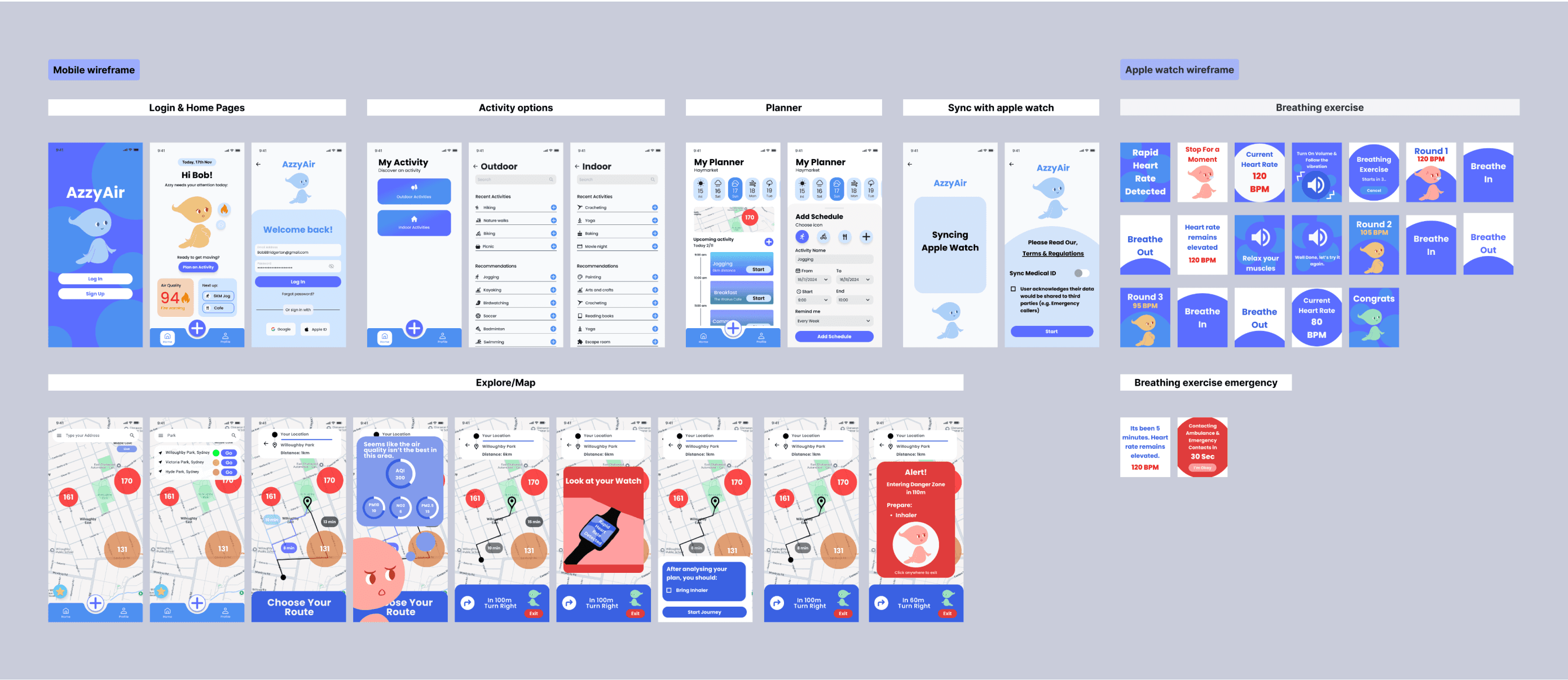
Before creating the high-fidelity prototype, we established a comprehensive style guide inspired by Material Design principles. Our goal was to craft a clean and intuitive visual design that ensured ease of use, focusing on readability and comfort for users navigating the app.
Before creating the high-fidelity prototype, we established a comprehensive style guide inspired by Material Design principles. Our goal was to craft a clean and intuitive visual design that ensured ease of use, focusing on readability and comfort for users navigating the app.
Typography | Poppins
Aa
Aa
Aa
Key learnings & Takeaways🔐
Key learnings & Takeaways🔐
One of my biggest takeaways was learning to iterate with intention. Rather than rushing to change the design in response to critical feedback, I learned to analyse feedback holistically, considering how each potential change could meaningfully enhance the user experience. This approach helped us make thoughtful, user-centred decisions that added real value to the product.
I also gained a deeper appreciation for collaborative ideation, structured testing, and user research synthesis, all of which played a key role in shaping our final solution.
As a result of our efforts, our team was awarded Best Product Research for PIP24C3, which reflected the strength of our process and our commitment to thoughtful, evidence-based design.
One of my biggest takeaways was learning to iterate with intention. Rather than rushing to change the design in response to critical feedback, I learned to analyse feedback holistically, considering how each potential change could meaningfully enhance the user experience. This approach helped us make thoughtful, user-centred decisions that added real value to the product.
I also gained a deeper appreciation for collaborative ideation, structured testing, and user research synthesis, all of which played a key role in shaping our final solution.
As a result of our efforts, our team was awarded Best Product Research for PIP24C3, which reflected the strength of our process and our commitment to thoughtful, evidence-based design.
Discover
Discover
Define
Define
Develop
Develop
Deliver
Deliver
Desktop Research
Desktop Research
Surveys & Interviews
Surveys & Interviews
Affinity Diagram
Affinity Diagram
Insights
Insights
User personas & jouneys
User personas & jouneys
Problem Statement
Problem Statement
Ideation
Ideation
Iterative design
Iterative design
User testing
User testing
Refine
Refine
Define style guide
Define style guide
Prototyping
Prototyping
A personal planner that allows users to schedule activities like jogging while considering their asthma condition.
A map feature similar to Google Maps, but enhanced to show areas with poor air quality, helping asthma users make safer, more informed decisions about where and when to be active.
Understanding the problem 🔎
Understanding the problem 🔎
Mid-fidelity🔨
Mid-fidelity🔨
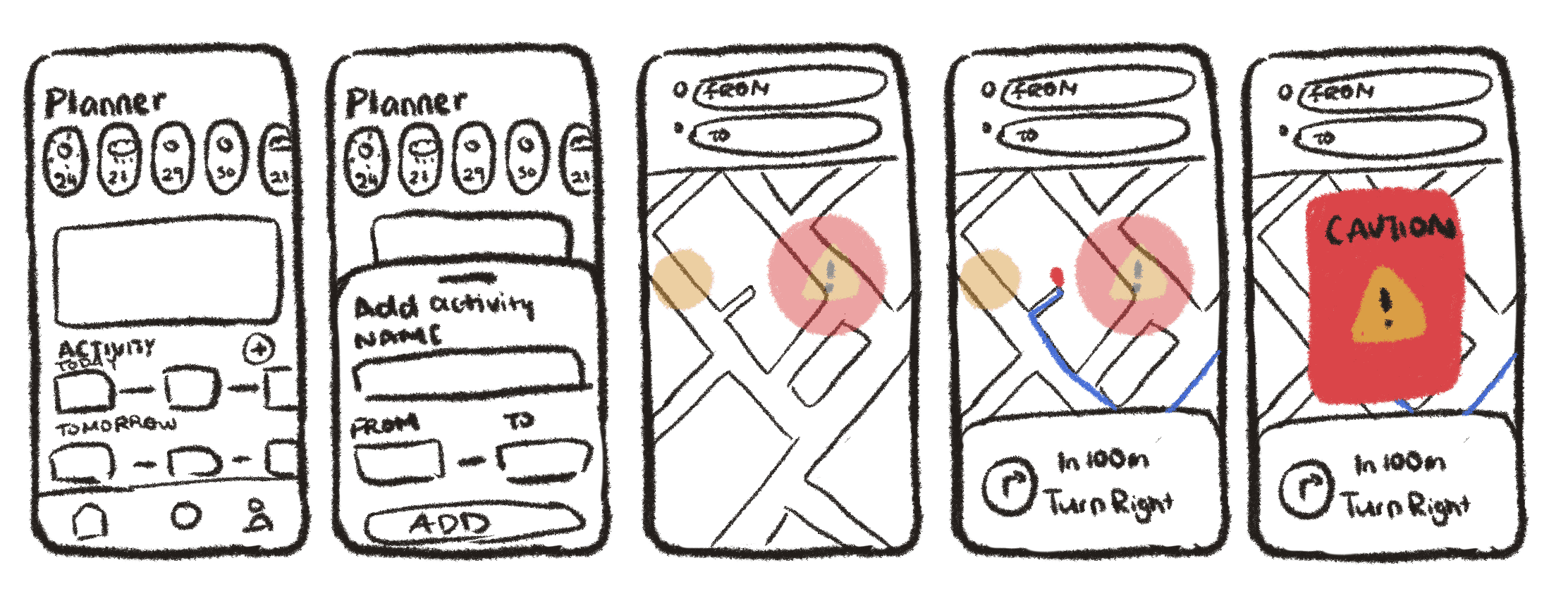
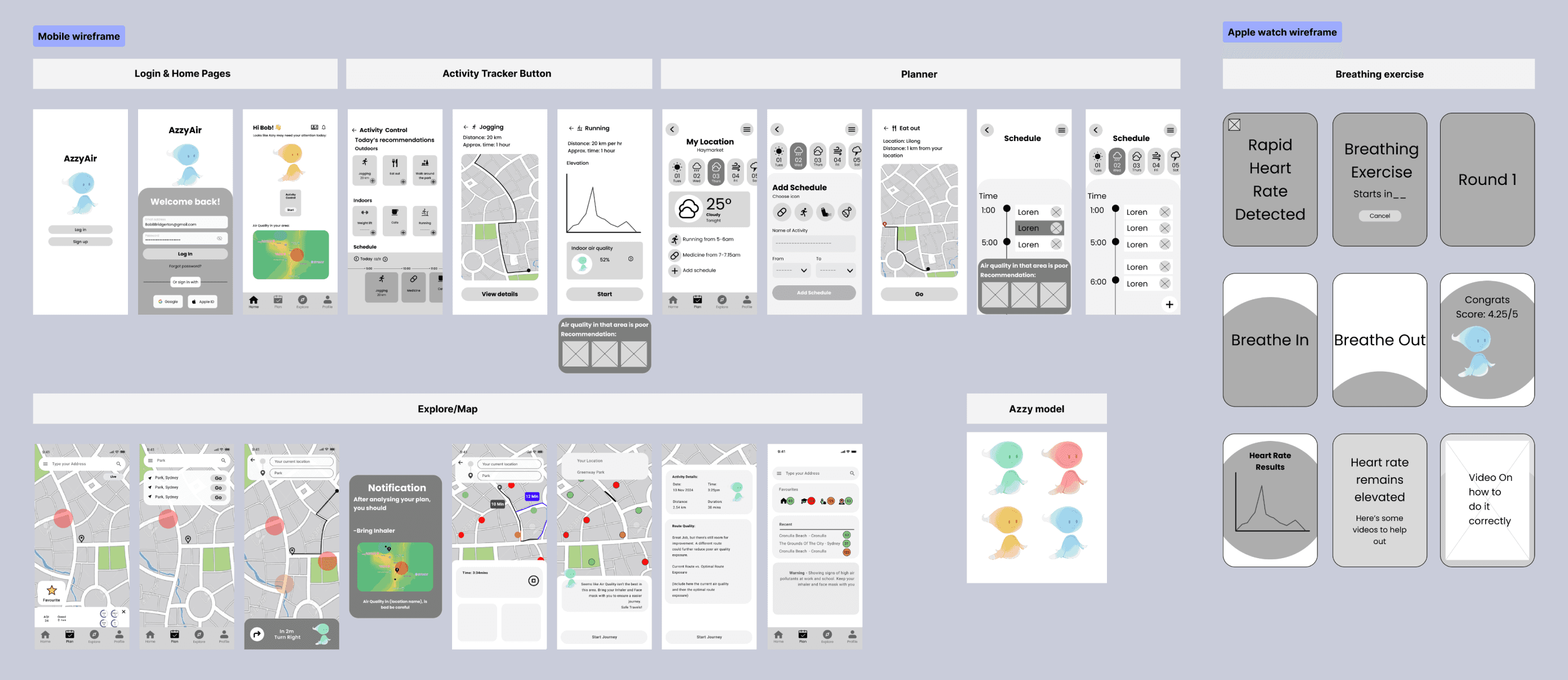
We created mid-fidelity prototypes in the form of digital wireframes on Figma. As we had various features to our solution, we used information architecture mapping to better visualise and understand how our prototype should flow. Additionally, we conducted user testing on these prototypes and iteratively refined our designs based on feedback to enhance usability and ensure a seamless user experience.
We created mid-fidelity prototypes in the form of digital wireframes on Figma. As we had various features to our solution, we used information architecture mapping to better visualise and understand how our prototype should flow. Additionally, we conducted user testing on these prototypes and iteratively refined our designs based on feedback to enhance usability and ensure a seamless user experience.
Primary/Main
Primary/Main
4E90F1
4E90F1
Secondary/Main
Secondary/Main
5B6DFF
5B6DFF
Accent/Main
Accent/Main
D0E5FF
D0E5FF
Body/Default
Body/Default
282828
282828
Background/Default
Background/Default
F8FAFC
F8FAFC
To evaluate the mid-fidelity prototype, we conducted think-aloud sessions, post-experience interviews, and a SUS (System Usability Scale) survey. As users navigated the app, they shared their thoughts in real time, revealing moments of confusion and suggesting improvements. While the SUS results indicated that the system was not overly complex to use, some users pointed out inconsistencies in elements such as font sizes, spacing and layout. These findings helped us make design improvements to make the app easier to use and understand.
Through this process, we identified three key usability issues:
Usability testing📊
Clearer feature relevance
“I think having one location as a title can be confusing as I felt that this represents more like a weather application. I think the title could be changed to something else more related to the plan.”
Streamline scheduling
“For the schedule page I would want to see my schedule as a whole, like not looking at the weather like it's the first thing you see but I want to check my schedule.”
Smarter activity planning
“I think it is better to give the user a better route because from what i'm seeing in the air quality page with the route it shows red which means it is dangerous right? like we don’t want to harm the user so is better to suggest them a better route”
How might we💭
How might we offer personalised digital support systems and improve information transparency to help asthma patients effectively manage their symptoms, thus integrating health management into their lifestyle to improve quality of life?
Defining the MVP🥇
As a group, we use the Crazy 8s technique to quickly generate a wide range of ideas, sketching out anything we thought could be useful for the app. Some of us came up with similar concepts, while others explored different directions. After discussing and evaluating the ideas, we initially narrowed our focus down to three MVP features: an activity tracker , a pill and inhaler tracker , and a healthcare provider connection tool .
However, after further iterations and feedback, we refined our MVP to focus on two core features: